Introduction
YouTube SEO is a process through which you can make your videos more visible on YouTube without paying for every view. But in 2026, getting recommended on YouTube is not only about adding keywords to your title and description.
The real game is viewer satisfaction.
YouTube’s recommendation system tries to show each viewer videos they are likely to watch and enjoy. It looks at things such as what viewers watch, what they ignore, their search and watch history, engagement, and satisfaction signals.
So, if you are still thinking, “How do I trick the YouTube algorithm?”, you are asking the wrong question.
Ask this instead:
“How can I make my target audience click, watch, enjoy, and want more?”
That’s where YouTube SEO and the algorithm become best friends.
And no, you don’t need to sacrifice a goat to the algorithm.
You need a better strategy.
Summary
The YouTube algorithm in 2026 is designed around one major goal: helping viewers find content they are likely to enjoy and keeping them satisfied over the long term.
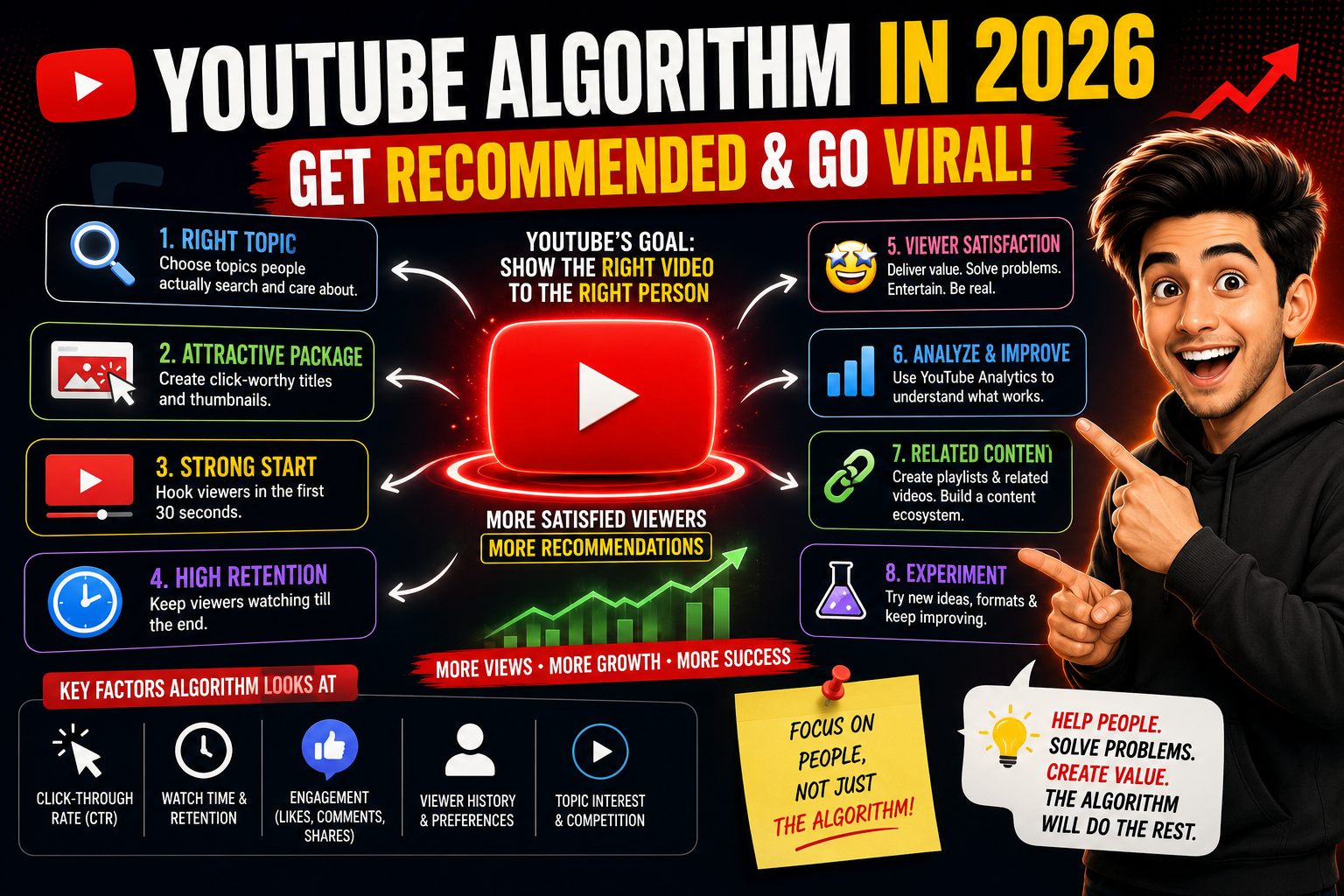
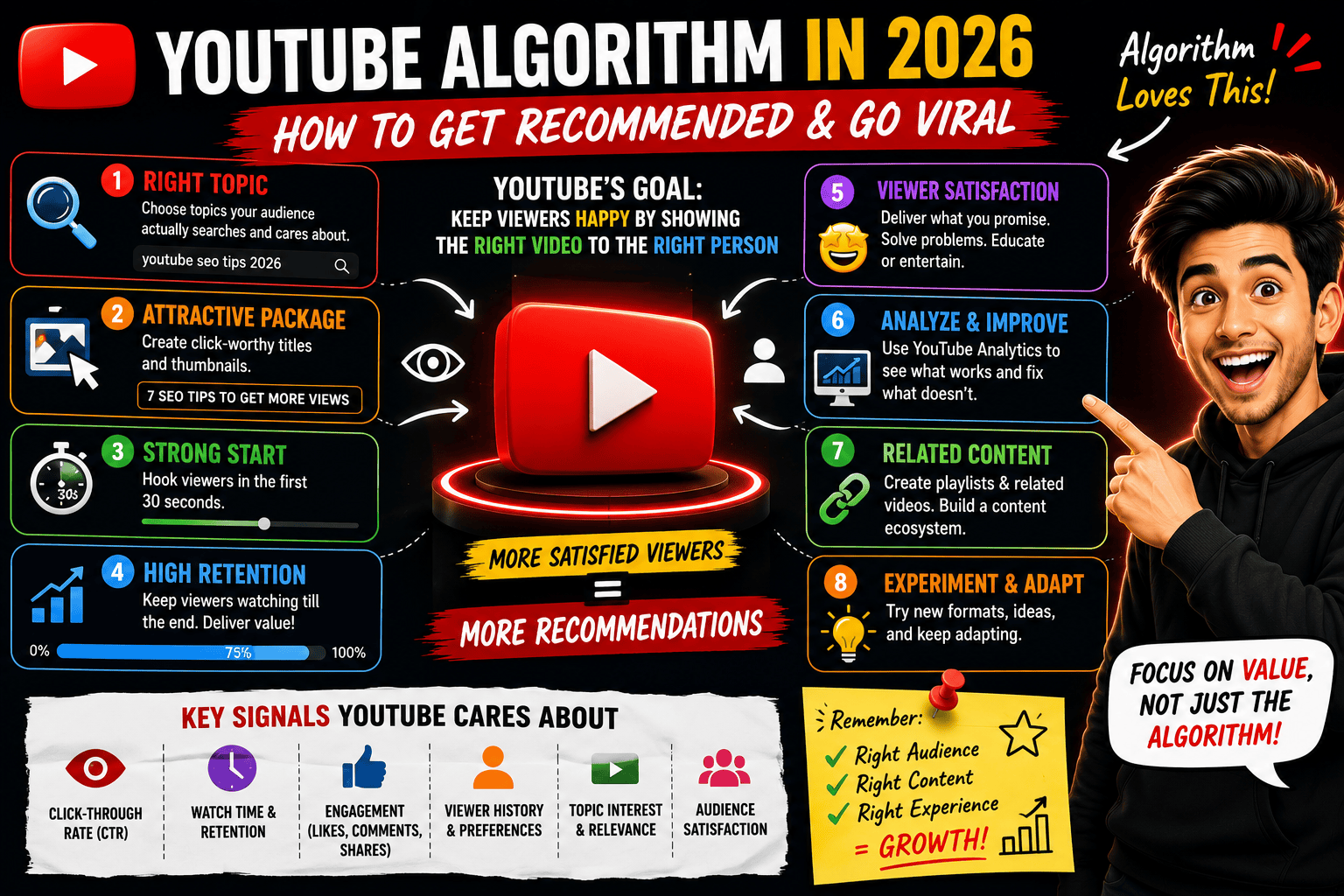
To increase your chances of getting recommended:
Choose topics your audience actually wants.
Create attractive titles and thumbnails.
Deliver what your title promises.
Make the beginning of your video interesting.
Keep viewers engaged throughout the video.
Study your YouTube Analytics.
Create related videos around the same topic.
Focus on viewer satisfaction instead of chasing “algorithm hacks.”
Experiment with different formats without worrying that the algorithm will automatically punish your channel.
The basic formula is:
Right Topic + Strong Packaging + Good Content + Viewer Satisfaction = More Recommendation Opportunities
Now let’s break it down.
1. Understand How the YouTube Algorithm Actually Works
First, forget the idea that there is one giant algorithm sitting in YouTube’s office drinking coffee and deciding:
“Hmm… should I give Rahul 500 views today?”
YouTube’s recommendation system is personalized. Different viewers can receive different recommendations based on their interests, viewing habits, searches, and interactions.
YouTube says its recommendation system mainly looks at two broad areas: viewer personalization and content performance. It also considers external factors such as topic interest and competition.
This means your video does not simply need to be “good.”
It needs to be good for a particular audience.
For example, a video about advanced SEO may be fantastic for digital marketers but completely boring for someone who only watches cooking videos.
The algorithm isn’t saying:
“This is a bad video.”
It is saying:
“This viewer probably doesn’t want this video.”
That’s an important difference.
2. Choose a Topic People Actually Want to Watch
Before worrying about tags, descriptions, or fancy editing, start with the topic.
If nobody cares about the topic, even the world’s greatest thumbnail designer will struggle.
For example:
Weak topic:
“My Thoughts About Marketing”
Better topic:
“7 Digital Marketing Mistakes Small Businesses Make”
The second topic addresses a clear problem.
You can find ideas by researching:
YouTube search suggestions
Questions your audience asks
Comments on related videos
Your YouTube Analytics
Popular topics within your niche
Videos your audience is already watching
YouTube also recommends understanding your audience and using the Audience section in Analytics to discover what your viewers watch and which topics or channels interest them.
Think of it like opening a restaurant.
You don’t ask, “What food do I personally feel like cooking?”
You ask, “What do my customers want to eat?”
Unless your customers are your family.
Then everyone wants free food.
3. Your Title and Thumbnail Must Earn the Click
Your title and thumbnail are your video’s packaging.
Before viewers experience your amazing content, they have to decide whether to click.
YouTube describes this stage as appeal: whether viewers choose to watch or ignore the content.
For example:
Basic title:
“YouTube SEO Tips”
Better title:
“7 YouTube SEO Tips to Get More Views in 2026”
Curiosity-based title:
“Why Your YouTube Videos Aren’t Getting Views in 2026”
Your thumbnail should support the title rather than repeat the entire sentence.
For example:
Title:
“Why Your YouTube Videos Aren’t Getting Views”
Thumbnail:
“NO ONE IS CLICKING!”
That’s more interesting than putting 25 words on the thumbnail in tiny text.
Remember:
Title gets attention. Thumbnail creates curiosity. Content delivers the promise.
4. The First 30 Seconds Can Make or Break Your Video
Imagine someone clicks your video and the first 30 seconds are:
“Hello guys, welcome back to my channel. Before starting, please subscribe, like, comment, share, follow me on Instagram, and don’t forget to turn on notifications…”
The viewer:
“Goodbye.”
Your introduction should quickly tell viewers why they should continue watching.
For example:
“If your videos are getting impressions but almost no views, I’m going to show you five things you can change today.”
Now the viewer understands:
What the problem is
What they will learn
Why they should stay
YouTube’s retention tools specifically help creators understand how well the opening holds viewers, including how many remain after the first 30 seconds.
So don’t spend the first minute introducing your childhood, your dog, your coffee, and the weather.
Get to the point.
5. Watch Time Is Not the Only Thing That Matters
Many creators believe:
“If I make a 30-minute video, YouTube will love me.”
No.
YouTube officially says there is no universal ideal video length. The right length depends on the content, audience, and purpose. Creators should focus on delivering value without unnecessary filler.
A useful 7-minute video can be better than a boring 30-minute video.
Imagine watching a tutorial about fixing a website.
If the creator explains the solution in 8 minutes, fantastic.
But if they stretch it to 35 minutes because they heard “long videos rank better,” viewers may leave.
The goal isn’t:
“Make people watch longer.”
The goal is:
“Make people want to keep watching.”
That’s a huge difference.
6. Create Videos That Satisfy Viewers
YouTube’s recommendation system looks beyond whether someone clicked.
It also considers engagement and satisfaction.
Imagine you create a video titled:
“How to Get 10,000 YouTube Views”
But after clicking, viewers discover 10 minutes of you explaining your morning routine.
That’s not satisfying.
Your title made a promise.
Your content needs to keep it.
A strong video should answer the viewer’s question, solve their problem, entertain them, or provide useful information.
Basically:
Don’t clickbait people into your video. Give them a reason to stay.
7. Use YouTube Analytics Like a Detective
YouTube Analytics is where you discover what your audience is actually doing.
Look at metrics such as:
Impressions
Click-through rate
Views
Average view duration
Audience retention
Watch time
Traffic sources
Returning viewers
YouTube describes content performance using three important areas: appeal, engagement, and satisfaction.
For example:
High impressions + low CTR
Your video is being shown, but people aren’t clicking.
Possible problem:
Title or thumbnail.
Good CTR + poor retention
People are clicking, but leaving quickly.
Possible problem:
The video isn’t delivering what the packaging promised.
Good retention + low impressions
People who discover the video seem to enjoy it, but the topic may have limited audience demand or strong competition.
This is why you shouldn’t judge a video using one metric alone. YouTube notes that CTR changes depending on traffic source and audience context.
Analytics is basically your YouTube report card.
Don’t throw it away because you don’t like the grades.
Read it.
8. Create Related Videos Instead of Random Videos
If you want YouTube to understand your channel, create content around connected topics.
For example, if your channel is about YouTube growth, create:
YouTube SEO for Beginners
YouTube Keyword Research
How to Create Better YouTube Titles
How to Design YouTube Thumbnails
How to Improve Audience Retention
YouTube Analytics Explained
Now viewers have multiple reasons to continue exploring your content.
YouTube also notes that having a substantial library of high-quality content can help new viewers discover more of your channel and build a stronger relationship with it.
One good video is great.
A connected library of good videos is better.
9. Don’t Be Afraid to Experiment
In 2026, creators don’t need to worry that experimenting with Shorts, long-form videos, livestreams, or other formats will automatically “confuse the algorithm.”
YouTube says its system evaluates content individually and tries to understand each viewer’s preferred topics and formats.
So you can experiment.
Try:
Shorts
Long-form videos
Live streams
Tutorials
Reviews
Case studies
Educational videos
Storytelling
But don’t randomly upload everything.
Experiment with a purpose.
If your audience loves tutorials, create more useful tutorials.
If they love case studies, create more case studies.
Let your audience give you the data.
10. Don’t Chase Viral Videos—Build Repeatable Success
Going viral sounds amazing.
Millions of views.
Thousands of subscribers.
Comments everywhere.
Then the next video gets 87 views.
Pain.
This happens because one viral video doesn’t automatically mean you understand your audience.
Instead of asking:
“How can I make one viral video?”
ask:
“What made people enjoy this video, and can I repeat that success?”
Look at your top-performing videos.
Find patterns:
Which topics performed best?
Which thumbnails attracted clicks?
Which introductions kept viewers watching?
Which videos generated returning viewers?
Which topics produced the most engagement?
Then create your next videos based on those insights.
That’s how you turn one successful video into a repeatable content strategy.
Real-Life Example
Let’s imagine a creator named Aman who runs a small digital marketing channel.
He uploads:
“My Digital Marketing Experience”
The thumbnail says:
“MY STORY”
After several days, the video gets very few views.
Aman thinks:
“The YouTube algorithm hates small creators.”
Instead of blaming YouTube, he studies his audience.
He discovers that viewers are searching for practical SEO tutorials.
So he creates:
“How to Do SEO for a New Website in 2026”
He creates a clear thumbnail:
“RANK YOUR WEBSITE”
He starts the video with the exact problem viewers want to solve.
He removes unnecessary introductions, explains the process clearly, and creates additional videos around keyword research, technical SEO, backlinks, and on-page SEO.
Now his channel has a clear content direction.
The lesson?
The algorithm isn’t your enemy. Confused content is.
Conclusion
The YouTube algorithm in 2026 is not a magical machine that randomly decides which creator becomes famous.
It is designed to match viewers with videos they are likely to watch and enjoy.
So stop trying to “beat” the algorithm.
Instead, understand your audience.
Create topics they care about.
Make titles and thumbnails that earn attention.
Deliver value quickly.
Keep viewers interested.
Study your analytics.
Improve your next video.
YouTube’s own guidance is clear: creators should focus less on decoding a secret algorithm and more on understanding what their audience enjoys.
The simple formula is:
Know Your Audience → Create Valuable Content → Package It Well → Keep Viewers Engaged → Analyze → Improve → Repeat
And maybe, just maybe, the algorithm will stop looking like your enemy.
Want more YouTube views without wasting money on paid ads?
Start with your next video.
Choose one topic your audience actually wants, create a strong title and thumbnail, deliver the promised value, and then study your analytics to see what happened.
Subscribe for more practical YouTube SEO, digital marketing, and content growth tips. Vidya Sarthi
And share this guide with that one friend who uploads a video called “My New Video 😎” and then checks YouTube Analytics every five minutes.
Your friend needs help.