Introduction
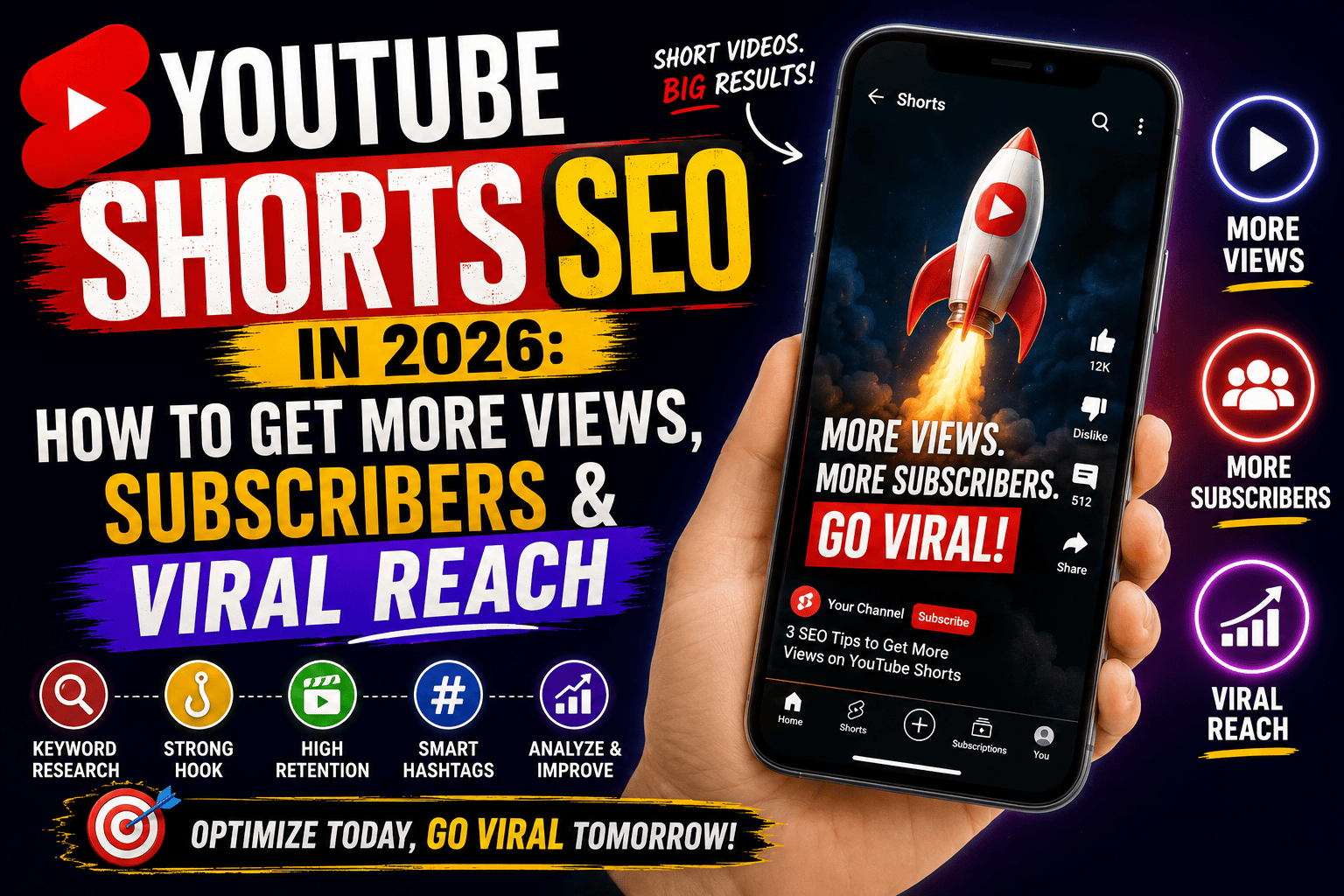
YouTube Shorts SEO is a process through which you can optimize your short videos so the right audience can discover, watch, and engage with them.
In 2026, Shorts are not only about making a 30-second video, adding #shorts, and praying to the YouTube algorithm.
If it were that easy, everyone would have 10 million subscribers.
YouTube says Shorts are ranked based on viewer personalization and performance. The system tries to match viewers with Shorts they are likely to watch and enjoy, using signals such as viewing behavior, topic interest, engagement, and how viewers respond when a Short is shown to them.
This means your goal should not be to “hack” the algorithm.
Your goal should be simple:
Make the right Short for the right audience and give them a reason to keep watching.
In this blog, we will learn how YouTube Shorts SEO works in 2026, how to get more views, how to turn viewers into subscribers, and how to increase your chances of getting viral reach without spending money on ads.
Summary
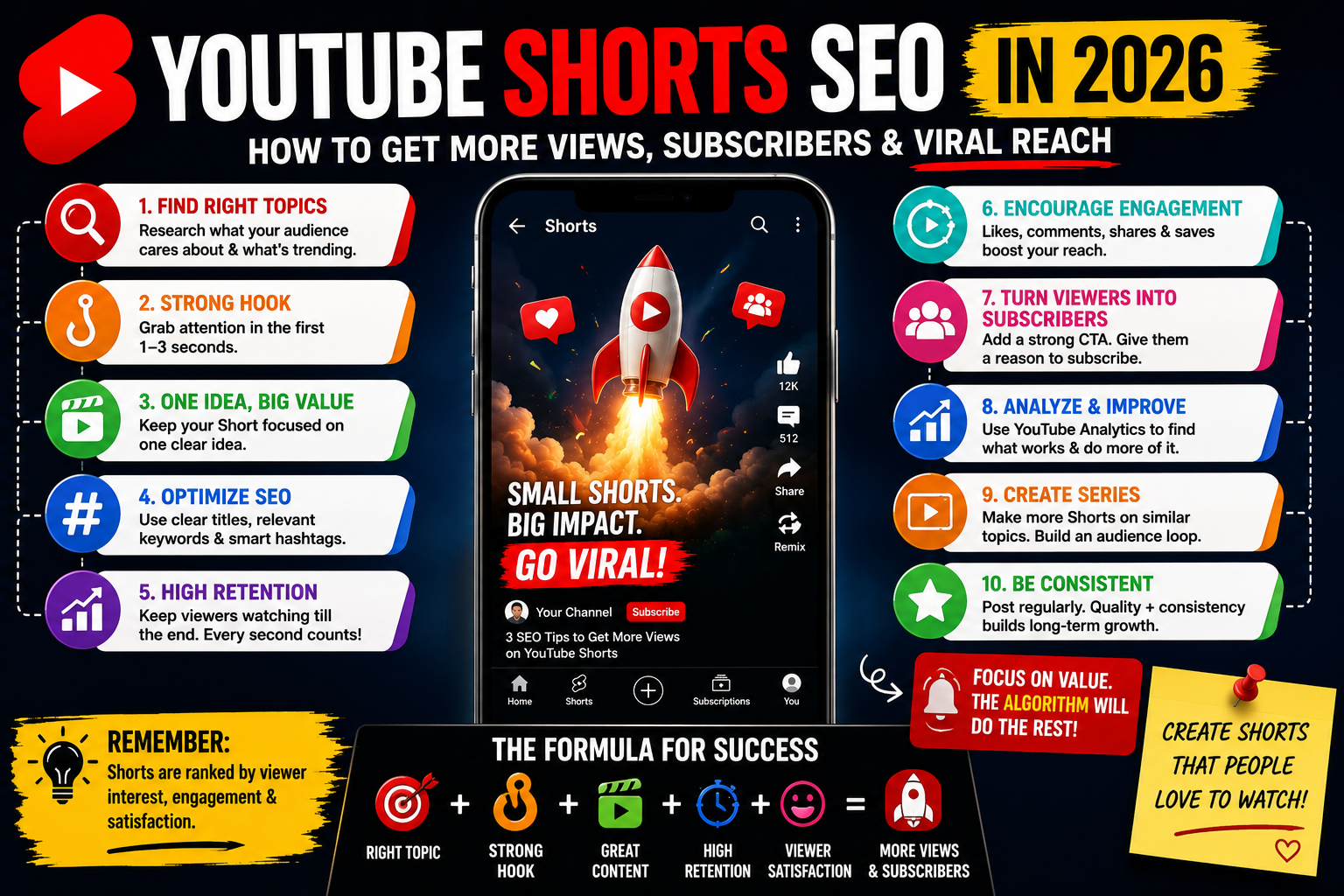
YouTube Shorts SEO in 2026 is mainly about topic selection, viewer interest, strong hooks, retention, engagement, metadata, and audience satisfaction.
To improve your Shorts performance:
Choose topics your audience already cares about.
Research keywords and search suggestions.
Create a strong hook in the first few seconds.
Keep the video focused on one idea.
Use clear titles and descriptions.
Add relevant hashtags instead of stuffing dozens of them.
Make videos people want to watch until the end.
Encourage meaningful comments and interaction.
Study Shorts Analytics.
Create more videos around topics that already work.
Give viewers a reason to subscribe.
The simple formula is:
Right Topic + Strong Hook + Great Content + Retention + Audience Satisfaction = More Reach
Now let’s break it down.
1. Understand How YouTube Shorts SEO Works in 2026
First, let’s remove one big misunderstanding.
There is no secret button called:
“MAKE THIS SHORT VIRAL.”
Unfortunately.
YouTube’s Shorts recommendation system is personalized. It tries to understand what each viewer enjoys and then recommends Shorts based on those interests and the performance of the content.
For example, imagine you upload a Short about SEO tips.
A person who regularly watches digital marketing, blogging, and SEO videos is more likely to be interested in it than someone who watches football highlights all day.
So YouTube tries to match your content with viewers who are more likely to enjoy it.
This is why knowing your audience is more important than chasing random viral trends.
2. Start With the Right Topic
Before recording your Short, ask:
“Does anyone actually care about this topic?”
This question can save you hours of editing.
For example:
Weak topic:
“Some SEO Things I Learned”
Better topic:
“3 SEO Mistakes That Can Hurt Your Website”
The second topic is more specific and immediately tells viewers what they will get.
You can find Shorts ideas through:
YouTube search suggestions
Questions from your audience
Comments on similar videos
Trending topics
Your existing analytics
Competitor content
Common problems in your niche
YouTube says topic interest and competition can influence how many people see a Short. Some topics naturally have a larger audience, while competition can make it harder for a video to win impressions.
So don’t only ask:
“What can I create?”
Ask:
“What problem can I solve?”
That’s a much better content strategy.
3. The First Few Seconds Are Extremely Important
With Shorts, viewers can swipe away incredibly quickly.
You don’t have five minutes to explain what your video is about.
You have to earn attention immediately.
For example, don’t start with:
“Hello everyone, welcome back to my channel. Today I am going to talk about…”
Instead:
“Your YouTube Shorts aren’t getting views? You’re probably making one of these three mistakes.”
Now the viewer has a reason to stay.
YouTube specifically recommends making the opening concise and delivering on the promise made by the title or thumbnail.
Your hook can use:
A question
A surprising fact
A common mistake
A bold statement
A problem
A result
A curiosity gap
For example:
“I changed one thing in my Shorts strategy, and my reach improved.”
Now people want to know:
“What did you change?”
Congratulations.
You have created curiosity without shouting “WAIT UNTIL THE END!!!” 17 times.
4. Keep One Short About One Main Idea
One of the biggest mistakes creators make is trying to explain everything in one Short.
Imagine a Short titled:
“Complete Digital Marketing Guide.”
Then the creator talks about:
SEO, Google Ads, Instagram, email marketing, websites, affiliate marketing, branding, AI, Facebook, and probably the creator’s lunch.
That’s too much.
Instead, create separate Shorts:
Short 1: 3 SEO mistakes beginners make
Short 2: How to find SEO keywords
Short 3: What is technical SEO?
Short 4: How Google understands a webpage
Now every Short has a clear purpose.
It also gives you more content from the same topic.
One idea can become five videos.
Your content calendar just got a promotion.
5. Optimize Your YouTube Shorts Title
Your title helps viewers understand what the Short is about and can also help with search discovery.
YouTube says search ranking considers relevance, engagement, and quality, with metadata such as the title and description helping determine how well content matches a search.
For example:
Weak:
“Watch This 😱”
Better:
“3 YouTube SEO Tips for More Views”
Curiosity-based:
“Why Your YouTube Shorts Get Views but No Subscribers”
The title should be clear and interesting.
Don’t make the viewer solve a puzzle before understanding your topic.
 6. Write a Useful Description
 6. Write a Useful Description
Many creators ignore the description because Shorts are short.
But your description can still provide context.
YouTube says descriptions help explain to both viewers and the system what a video is about, and recommends using relevant words prominently in the title and description.
For example:
Title:
“YouTube Shorts SEO: 5 Tips to Get More Views”
Description:
“Learn how to optimize YouTube Shorts in 2026 with better topics, hooks, keywords, retention, and audience engagement.”
Simple.
Clear.
Relevant.
You don’t need to write a 2,000-word essay underneath a 20-second Short.
The Short already did the talking.
7. Use Hashtags—But Don’t Turn Your Description Into a Hashtag Forest
Hashtags can help connect your content with related videos and search results.
YouTube allows hashtags in the title and description, and up to three engaging hashtags from the description may appear near the video title.
For an SEO Short, you might use:
#YouTubeSEO #YouTubeShorts #SEO
That’s enough.
Avoid:
#youtube #shorts #viral #fyp #trending #youtubeviral #views #subscribe #explore #seo #marketing #business #contentcreator #creator #algorithm #2026
At some point, it stops looking like SEO and starts looking like your keyboard sneezed.
Use hashtags that actually describe the content.
8. Focus on Retention and Viewer Satisfaction
Getting a view is nice.
Getting someone to watch and enjoy your Short is better.
YouTube says recommendation performance can be understood through three broad areas:
Appeal: Did viewers choose to watch?
Engagement: Did they stick around?
Satisfaction: Did they enjoy the experience?
This gives you a simple way to think about your Short.
Step 1: Get attention.
Your hook needs to stop the swipe.
Step 2: Keep attention.
The content should move quickly and avoid unnecessary filler.
Step 3: Deliver value.
The viewer should feel that watching your Short was worth their time.
For example, if you promise:
“3 ways to get more YouTube views”
don’t spend the first 20 seconds talking about your breakfast.
Give the three tips.
Your audience came for information, not your toast.
9. Create a Strong Ending
Don’t let your Short suddenly end like:
“So yeah… that’s it.”
Give viewers a reason to take the next step.
For example:
“Follow for more YouTube SEO tips.”
Or:
“Want the full strategy? Check out my longer video.”
Or:
“Comment ‘SEO’ and I’ll share the next tip.”
Your CTA should be connected to the content.
Don’t scream:
“SUBSCRIBE! LIKE! COMMENT! SHARE! FOLLOW! BUY! JOIN! DO EVERYTHING!”
Viewers have one thumb.
Be reasonable.
10. Turn Shorts Viewers Into Subscribers
Getting views is great.
But subscribers can become a long-term audience.
Imagine you make a Short:
“3 YouTube SEO mistakes beginners make.”
A viewer enjoys it.
At the end, you can tell them:
“If you want more practical YouTube SEO tips, subscribe because I post new strategies every week.”
That’s a natural reason to subscribe.
Your Shorts should introduce people to your larger content ecosystem.
For example:
Short → Related Short → Long-form video → Subscribe
YouTube also notes that viewers can discover creators across different formats, including Shorts and long-form videos, although individual viewer preferences vary.
11. Use YouTube Analytics to Find What Works
You don’t need to guess which Shorts are working.
YouTube Analytics gives you data.
For Shorts, pay attention to metrics and reports such as:
Views
Subscribers gained
Shown in feed
How many chose to view
Traffic sources
Likes
Comments
Audience behavior
Top-performing Shorts
YouTube specifically highlights “Shown in feed” and “How many chose to view” as useful Shorts metrics for understanding performance.
For example, suppose you publish three Shorts:
Short A: 2,000 views
Short B: 15,000 views
Short C: 1,500 views
Don’t simply celebrate Short B.
Study it.
What was different?
Maybe:
Better topic
Stronger hook
Better pacing
More interesting storytelling
Better timing
Better audience fit
Then make another Short based on what you learned.
That’s how you turn analytics into strategy.
12. Don’t Copy Viral Videos—Understand Why They Worked
You will see viral Shorts everywhere.
Your first thought may be:
“I’m going to copy this exactly.”
Don’t.
Instead, study the structure.
Ask:
What made people stop scrolling?
What was the hook?
How quickly did the video deliver value?
What emotion did it create?
Was the topic already popular?
What made people comment or share?
How was the ending structured?
Then create your own version using your own knowledge, examples, personality, and experience.
Copying a viral Short gives you one video.
Understanding why it worked gives you a content strategy.
13. Don’t Feel You Must Upload Every Hour
Some creators believe:
“If I don’t upload five Shorts every day, YouTube will forget me.”
That’s not how it works.
YouTube says there is no minimum posting cadence required for Shorts to perform well. Instead, creators should identify what works for their audience and focus on creating good content.
Quality beats panic.
If you can create three excellent Shorts per week, that’s better than uploading 20 random videos that nobody wants to watch.
Consistency is useful.
But consistency without quality is just consistent disappointment.
Real-Life Example
Let’s imagine Rohit, a beginner YouTube creator.
He uploads Shorts about digital marketing.
His first Short is:
“Digital Marketing Tips”
It gets 300 views.
He then changes his strategy.
His next Short is:
“3 SEO Mistakes Killing Your Website Traffic”
The opening says:
“If your website isn’t getting traffic, check these three SEO mistakes first.”
He uses a clear title, a simple description, relevant hashtags, fast editing, and gives three useful tips.
The Short performs much better.
So Rohit doesn’t stop there.
He creates:
“3 SEO mistakes beginners make”
“How to find keywords in 30 seconds”
“Why your website isn’t ranking”
“Technical SEO explained in 20 seconds”
“3 ways to improve your title tags”
Now he has a content series.
Instead of hoping for one viral video, he is building a library around a topic his audience cares about.
That’s the real power of Shorts SEO.
YouTube Shorts SEO Checklist for 2026
Before publishing your next Short, ask:
Topic
Is this something my audience actually cares about?
Does it solve a problem or provide entertainment?
Hook
Does the first few seconds create curiosity?
Does it immediately explain why viewers should keep watching?
Content
Is there one clear idea?
Is the information useful?
Did I remove unnecessary filler?
SEO
Is my main topic clear in the title?
Is my description relevant?
Are my hashtags related to the content?
Engagement
Does the video encourage viewers to think, comment, or share?
Is there a natural reason to subscribe?
Analytics
Did viewers choose to watch instead of swipe away?
Which Shorts are gaining subscribers?
Which topics are performing best?
What can I improve in the next video?
Conclusion
YouTube Shorts SEO in 2026 is not about stuffing keywords, adding 50 hashtags, or waiting for the algorithm to magically make you famous.
It is about understanding your audience and creating Shorts they actually want to watch.
YouTube’s own guidance says Shorts are matched to viewers based on personalization and performance, while factors such as topic interest and competition can also affect reach.
So focus on the things you can control:
Choose better topics.
Create stronger hooks.
Keep viewers engaged.
Deliver real value.
Use relevant SEO.
Study your analytics.
Repeat what works.
The formula is simple:
Right Audience + Right Topic + Strong Hook + Valuable Content + Smart Optimization = More Views + More Subscribers + More Reach
And remember, viral reach is never guaranteed.
But every Short is an opportunity to learn what your audience wants next.
Ready to grow your YouTube channel with Shorts?
Start with your next video.
Choose one problem your audience has, create a powerful hook, deliver the solution quickly, optimize the title and description, and check your analytics after publishing.
Subscribe for more practical YouTube SEO, digital marketing, and content growth tips.Vidya Sarthi
And if this guide helped you, share it with a creator who is still using #viral #fyp #trending #subscribe #shorts #pleasewatchmyvideo on every Short.
Their hashtag collection needs an intervention.