Introduction
YouTube SEO is the process through which you can make your videos more visible on YouTube without paying for every view. In simple words, you are helping YouTube understand your video and show it to the right people.
In 2026, uploading a video and saying, “Now YouTube will make me famous” is not exactly a strategy. Otherwise, every person with a smartphone would have 1 million subscribers by Friday.
YouTube looks at many things such as title, thumbnail, keywords, watch time, audience retention, engagement, and viewer satisfaction to understand whether your video deserves more visibility.
The good news? You don’t need a huge advertising budget to get views. With the right YouTube SEO strategy, even a small channel can compete with bigger creators.
Summary
YouTube SEO in 2026 is not only about adding keywords to your title and description. It is about creating a video that:
People are actually searching for
People want to click
People continue watching
Answers the viewer’s question
Keeps viewers satisfied
Gives YouTube enough information to understand the topic
Think of YouTube like a waiter in a busy restaurant.
If you say, “Give me food,” the waiter has no idea what you want.
But if you say, “I want a spicy paneer pizza without onions,” suddenly the job becomes much easier.
Your video works the same way. The clearer your topic, title, description, and content are, the easier it is for YouTube to understand who should see your video.
1. Start With YouTube Keyword Research
Before creating a video, first find out what people are searching for.
Don’t create a video just because you think the topic is interesting. Your audience may not care.
For example, suppose you run a digital marketing channel.
Instead of making a video titled:
“My Thoughts About SEO”
you could target a more specific search:
“SEO for Beginners: How to Rank a Website in 2026”
The second topic tells both YouTube and viewers exactly what the video is about.
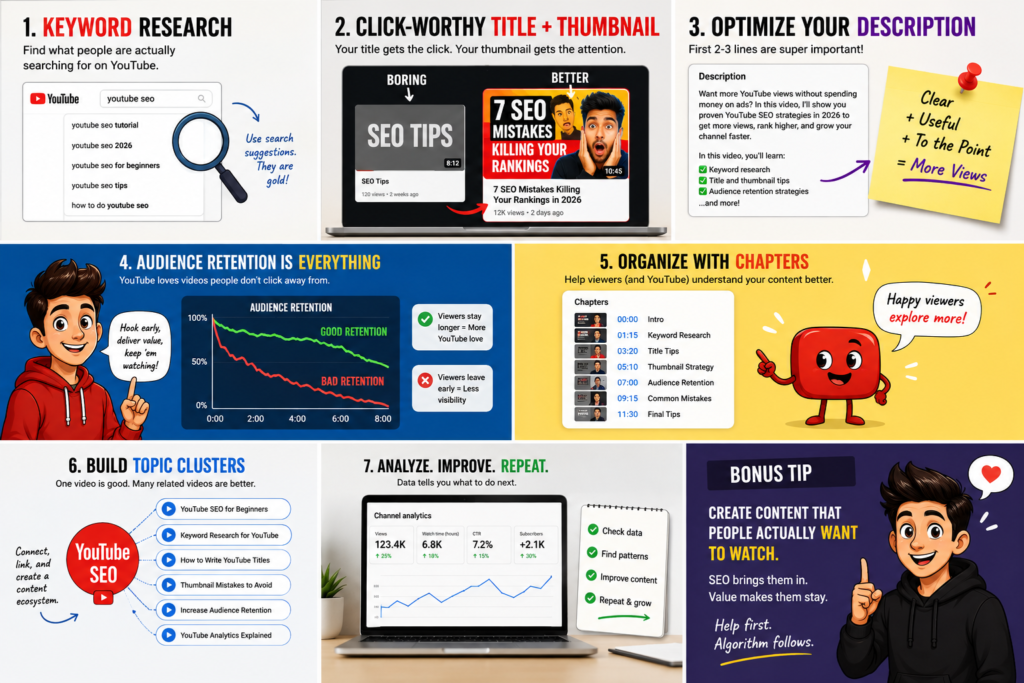
You can use YouTube’s search suggestions to find real topics people are searching for. Type your main keyword into YouTube and look at the suggestions.
For example:
SEO → SEO for beginners → SEO for beginners 2026 → SEO tutorial for beginners
These suggestions can give you content ideas directly from user searches.
Funny rule:
Don’t create content for yourself unless you are also your target audience.
Your audience doesn’t wake up thinking, “I wonder what this creator feels about SEO today.”
They wake up thinking, “How do I get my website on Google without becoming bankrupt?”
Solve that problem.
2. Create a Click-Worthy YouTube Title
Your title has two jobs:
Tell YouTube what the video is about.
Convince people to click.
A good title should include the main topic naturally while creating curiosity.
For example:
Weak:
“SEO Tips”
Better:
“7 SEO Tips to Rank Higher on Google in 2026”
More interesting:
“7 SEO Mistakes Killing Your Google Rankings in 2026”
The third title creates curiosity because people naturally want to know whether they are making those mistakes.
But don’t create clickbait.
If your title says “Get 1 Million Views Overnight” and the video teaches how to upload a video, viewers will probably leave faster than a cat leaves a bathtub.
Your title should make a promise that your video actually delivers.
3. Your Thumbnail Is Your Digital Shop Window
A thumbnail is one of the first things viewers notice.
Think about YouTube like a shopping mall.
Your video is the product, but your thumbnail is the shop window.
If the shop window looks boring, people keep walking.
Your thumbnail should be:
Easy to understand
Visually clear
Relevant to the video
Not overloaded with text
Designed to create curiosity
For example, if your video is about “5 YouTube SEO Mistakes,” your thumbnail could use a simple visual showing a falling view graph and the words:
“STOP DOING THIS!”
You don’t need to put the entire title on the thumbnail.
The title and thumbnail should work together instead of repeating each other.
4. Use Your Main Keyword Naturally
Keywords still matter, but keyword stuffing is not the secret cheat code.
Use your primary keyword naturally in places such as:
Video title
Description
Spoken content
Relevant tags or metadata where useful
Chapters
Related content
For example, if your target keyword is “YouTube SEO,” you can naturally say:
“In this video, I’m going to explain how YouTube SEO works in 2026.”
This helps provide context about the topic.
But don’t write something like:
“YouTube SEO YouTube SEO YouTube SEO best YouTube SEO YouTube SEO 2026.”
That doesn’t look optimized.
It looks like your keyboard got stuck.
5. Write a Useful Video Description
Your description gives additional context about your video.
The first few lines are especially important because viewers may see them before clicking “show more.”
Start by clearly explaining what the video covers.
For example:
“Want more YouTube views without spending money on ads? In this video, we’ll explain how YouTube SEO works in 2026, including keyword research, titles, thumbnails, audience retention, and video optimization.”
Then you can add:
Important points covered
Relevant resources
Timestamps
Links to related videos
Calls to action
Don’t turn the description into a keyword graveyard.
Write for humans first.
6. Audience Retention Is Extremely Important
Getting someone to click your video is only half the battle.
The bigger question is:
Do they stay?
Imagine you own a restaurant.
A customer enters, looks at the menu for five seconds, and runs away.
You probably wouldn’t say, “Great customer retention!”
YouTube has a similar problem.
If viewers click your video and leave quickly, it can be a signal that the video didn’t satisfy their expectation.
So your introduction should get to the point quickly.
Instead of:
“Hello guys, welcome back to my channel. Before we start, don’t forget to like, subscribe, comment, share, follow me on Instagram, and please…”
The viewer:
Exit → YouTube Shorts → Three hours disappear.
Instead, start with the problem and promise.
For example:
“If your YouTube videos are getting impressions but almost no views, these five SEO mistakes could be the reason. Let’s fix them.”
Now the viewer has a reason to stay.
7. Give Viewers What You Promised
One of the biggest YouTube SEO mistakes is creating a strong title and thumbnail but weak content.
For example:
Title:
“How I Got 100,000 YouTube Views Without Ads”
Then the video spends eight minutes talking about your morning coffee.
Nobody came to see your coffee.
They came for the 100,000-view strategy.
Your content should deliver the promise made by your title and thumbnail.
This improves the overall viewer experience and can help your video perform better.
8. Use Chapters to Improve the Viewing Experience
For longer videos, chapters can make the content easier to navigate.
For example:
00:00 Introduction
01:15 YouTube Keyword Research
03:20 How to Create Better Titles
05:10 Thumbnail Strategy
07:00 Audience Retention
09:15 Common YouTube SEO Mistakes
This is useful for viewers who want to jump to a specific section.
It also makes your video look more organized and professional.
9. Create Content Around One Clear Topic
One video should ideally have one main purpose.
For example, don’t make a video titled:
“YouTube SEO + Instagram Marketing + Facebook Ads + Blogging + Email Marketing + My Favorite Pizza.”
That’s not a video.
That’s a digital buffet.
Instead, create focused videos:
YouTube SEO for beginners
How to write YouTube titles
How to improve YouTube thumbnails
How to increase audience retention
YouTube keyword research tutorial
Focused content makes it easier for viewers to understand what they are getting.
It also helps you build topical authority over time.
10. Build Topic Clusters
Don’t depend on one video.
Create multiple videos around related topics.
For example, if your channel is about YouTube SEO, you could create:
Video 1: YouTube SEO for Beginners
Video 2: YouTube Keyword Research
Video 3: How to Write YouTube Titles
Video 4: YouTube Thumbnail Mistakes
Video 5: How to Increase Audience Retention
Video 6: YouTube Analytics Explained
Then connect these videos through playlists, end screens, cards where appropriate, and links in descriptions.
Now one video can lead viewers to another.
That’s how you turn a channel into a content ecosystem instead of a collection of random videos.
11. Don’t Ignore YouTube Analytics
YouTube Analytics can tell you what is working and what is not.
Pay attention to metrics such as:
Impressions
Click-through rate
Watch time
Audience retention
Traffic sources
Returning viewers
Engagement
For example, suppose your video gets lots of impressions but very few clicks.
That could suggest your title or thumbnail needs improvement.
Now imagine another video gets many clicks but viewers leave quickly.
Your packaging worked, but the content may not be delivering the expected value.
Analytics helps you identify these problems instead of blindly uploading another video and hoping for magic.
12. Create Videos People Want to Watch, Not Just Videos You Want to Rank
This is probably the most important YouTube SEO lesson.
SEO can help people discover your video.
But good content gives them a reason to stay.
Imagine two videos:
Video A: Perfect keywords, terrible content.
Video B: Good SEO, strong presentation, useful information, and high viewer satisfaction.
Video B has a much better chance of building a real audience.
So don’t think of YouTube SEO as a trick to fool the algorithm.
Think of it as a way to help the right audience discover useful content.
Real-Life Example
Let’s say Rahul has a small YouTube channel about digital marketing.
He uploads a video titled:
“SEO Tips”
The thumbnail says:
“SEO”
The video starts with a 45-second introduction about his channel.
After two weeks, the video gets only 120 views.
Rahul thinks:
“YouTube hates small creators.”
But instead of blaming YouTube, he changes the strategy.
He researches specific topics and creates:
“SEO for Beginners: 7 Steps to Rank Your Website in 2026”
He creates a simple, clear thumbnail:
“RANK HIGHER”
He starts the video by explaining exactly what viewers will learn.
He adds relevant keywords naturally, chapters, examples, and links to related videos.
After publishing several focused videos, Rahul starts getting traffic from YouTube Search and recommended videos.
The lesson isn’t that every optimized video will suddenly get millions of views.
The lesson is that clear targeting + useful content + strong packaging + audience satisfaction gives your videos a much better opportunity to be discovered.
And yes, Rahul can still keep his coffee.
Conclusion
YouTube SEO in 2026 is not about finding one magical keyword and putting it 37 times in your description.
It is about understanding what people want, creating a video that solves their problem, packaging it with a strong title and thumbnail, and keeping viewers interested.
The basic formula is simple:
Research → Create → Optimize → Publish → Analyze → Improve → Repeat
You don’t need paid ads to start getting more views.
You need better content, better optimization, and a little patience.
Because YouTube success usually doesn’t happen after uploading one video and staring at the analytics every 11 seconds.
Keep learning, keep testing, and keep improving.
Want to grow your YouTube channel without wasting money on paid ads?
Start applying these YouTube SEO strategies to your next video.
Join to Vidya Sarthi for more practical SEO, digital marketing, and YouTube growth tips.
And if you found this guide useful, share it with a creator who is still uploading videos with the title “My New Video 😎” and wondering why nobody is watching.