YouTube Monetization Policy 2026
Introduction
YouTube has become one of the most popular platforms for creators, businesses, educators, and influencers to build an audience and earn money online. However, getting views is not the only requirement for earning from YouTube. Creators also need to understand the platform’s monetization requirements and create content that provides real value to viewers.
The YouTube Monetization Policy 2026 is especially important for creators who want to build a long-term income source from their channels. Monetization is connected to content quality, originality, audience value, and compliance with YouTube’s policies.
In this guide, we will discuss the major areas creators should understand in 2026, how YouTube monetization rules affect content creators, and what you can do to keep your channel ready for monetization.
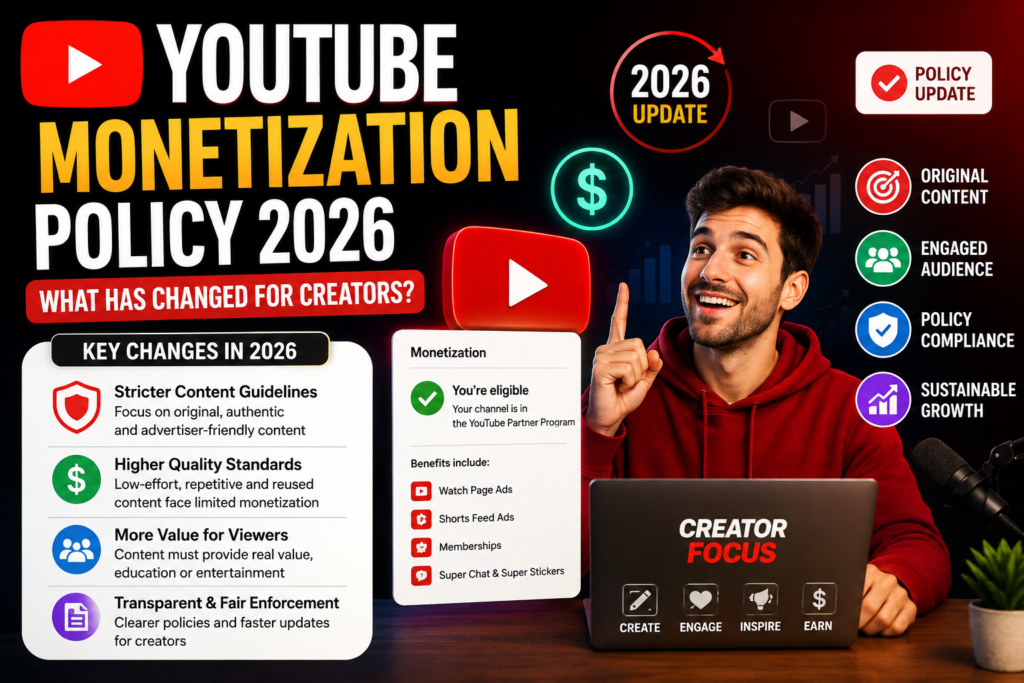
YouTube Monetization Policy Update
The biggest lesson for creators in 2026 is that publishing content consistently is not enough. YouTube increasingly focuses on whether content is useful, original, engaging, and created for viewers rather than simply produced to generate advertising revenue.
Creators should pay attention to the following areas:
- Original and meaningful content
- Useful information or entertainment
- Avoiding repetitive or low-value uploads
- Following community and advertiser-friendly policies
- Building genuine audience engagement
- Maintaining a consistent content strategy
This means creators should think beyond simply reaching a particular number of subscribers or views. A channel needs to demonstrate that its content deserves to be monetized.
The uploaded SEO guide also emphasizes the importance of writing for humans first while structuring content properly for search engines. The same principle can be applied to YouTube content: create videos for viewers first, then optimize them for discovery.
YouTube Monetization Rules Creators Should Know
Understanding the basic YouTube monetization rules can help creators avoid problems later. Monetization is generally connected to eligibility requirements, policy compliance, and the overall quality of a channel.
Creators should carefully review their content before applying for monetization. Videos that are repetitive, misleading, copied, or provide little original value can create problems for a channel.
Instead of producing large quantities of similar videos, focus on creating content with a clear purpose.
For example, a creator running a digital marketing channel could publish:
- Step-by-step tutorials
- Original case studies
- Marketing strategy explanations
- Product or tool reviews with personal analysis
- Educational videos based on practical experience
These formats can provide more value than simply repeating information that viewers can find everywhere.
What Creators Should Understand About Content Quality
Content quality is one of the most important parts of a successful YouTube strategy.
A monetized channel should not be built around quantity alone. Uploading ten weak videos is not necessarily better than uploading two useful videos that solve real audience problems.
Before publishing a video, ask yourself:
Does this video teach, inform, entertain, or help the viewer?
If the answer is yes, the content has a stronger foundation.
Creators should also avoid creating videos that feel automatically produced or unnecessarily repetitive. If you use AI tools during research, scripting, editing, or production, the final video should still contain meaningful human input and provide genuine value.
Originality Matters More Than Ever
Originality is an important factor for creators who want sustainable monetization.
Using another creator’s video, script, images, or audio without adding meaningful value can create copyright or monetization problems. Even when you use publicly available information, your presentation should add something useful.
You can make content more original by adding:
- Your own explanation
- Personal experience
- Original examples
- Commentary
- Demonstrations
- Research
- Comparisons
- Unique opinions supported by evidence
The goal is not simply to repeat information. The goal is to transform information into something useful for your particular audience.
Avoid Repetitive and Low-Value Content
One of the biggest mistakes creators make is assuming that more uploads automatically mean more earnings.
A channel can publish many videos while offering very little new information. Repetitive content can make it difficult to build audience trust and can also create monetization concerns.
For example, imagine a channel uploading hundreds of videos using almost the same script, structure, visuals, and narration. Even if every video has a different title, the actual viewer experience may remain almost identical.
Therefore, creators should focus on meaningful differences between videos.
Each upload should answer a new question, provide a new perspective, demonstrate something different, or offer a clear benefit to the viewer.
AI Content and YouTube Monetization
AI tools have changed how creators research, write scripts, generate ideas, edit videos, and produce visual assets.
However, using AI does not automatically make content valuable.
The important question is how the creator uses the technology.
AI can help with:
- Brainstorming video topics
- Organizing research
- Creating first-draft scripts
- Generating content ideas
- Improving titles
- Planning video structures
- Supporting editing workflows
However, creators should add their own expertise, analysis, examples, storytelling, and creative direction.
A useful approach is to treat AI as a production assistant rather than a replacement for the creator.
How to Make Your Channel More Monetization-Friendly
Creators who want to build a monetizable channel should develop a clear content strategy.
Start by identifying the audience you want to reach. Then understand what problems they have and what questions they search for.
This approach is similar to the keyword research process explained in the uploaded SEO guide. The guide recommends starting with keyword research and selecting relevant topics that solve real problems.
For YouTube, you can apply the same idea by researching:
- What viewers are searching for
- Which questions appear repeatedly
- What competitors are covering
- Where existing videos lack useful information
- Which topics match your expertise
Then create videos that provide a better or more useful answer.
Optimize Your Videos for Search
Monetization and SEO are different, but SEO can help your videos reach more viewers.
Use your main topic naturally in the video title, description, spoken content, and relevant metadata. Avoid stuffing keywords into every part of the video.
The uploaded guide specifically warns against keyword stuffing and recommends natural keyword placement.
Your YouTube optimization can include:
Create a Clear Title
Your title should tell viewers exactly what they will learn or gain.
Instead of using a vague title such as:
“My New YouTube Video”
use something more descriptive:
“YouTube Monetization Tips for New Creators in 2026”
Write a Useful Description
The description should explain what the video covers. Add relevant keywords naturally and include links where appropriate.
Use an Attractive Thumbnail
A thumbnail should communicate the video’s main idea quickly. Keep the design simple and readable, especially on mobile devices.
Organize Content With Structure
Long videos should have a clear introduction, main sections, examples, and conclusion.
This also follows the SEO guide’s recommendation to use clear hierarchy, short paragraphs, simple language, and transition words to improve readability.
Common Mistakes That Can Hurt Creators
Many creators focus so much on views that they forget about policy compliance.
Some common mistakes include:
- Copying content from other creators
- Publishing repetitive videos
- Using copyrighted material without proper rights
- Creating misleading titles or thumbnails
- Ignoring advertiser-friendly requirements
- Producing content without adding original value
- Focusing entirely on automation
- Ignoring audience feedback
Avoiding these mistakes can help create a stronger foundation for long-term channel growth.
A Simple 2026 Monetization Strategy
If you are building a new YouTube channel, follow a simple process.
Step 1: Choose a specific niche.
Pick a topic where you can consistently provide useful information.
Step 2: Research audience problems.
Find questions, challenges, and topics that people are actively interested in.
Step 3: Create original videos.
Add your own knowledge, examples, opinions, demonstrations, or experiences.
Step 4: Optimize every upload.
Create a clear title, useful description, relevant keywords, and an attractive thumbnail.
Step 5: Study performance.
Look at watch time, audience retention, engagement, and traffic sources.
Step 6: Improve continuously.
Use your analytics and audience feedback to make future videos better.
This process combines content quality with search-friendly organization. The SEO guide similarly recommends balancing useful content, keyword placement, readability, links, and technical performance.
Conclusion
The YouTube Monetization Policy 2026 shows creators why sustainable content matters more than simply producing a high volume of videos. Building a monetized channel requires more than views and subscribers. Creators should focus on originality, usefulness, audience experience, and policy compliance.
The most important approach is simple: create content for people first and optimize it for discovery second.
If you use AI, automation, or other tools, make sure your videos still contain meaningful creative input and provide genuine value. Avoid repetitive content, copied material, and misleading strategies.
Finally, remember that YouTube is constantly evolving. Creators should regularly review official policy updates and adapt their content strategy instead of relying on old monetization practices.
A channel built around useful, original, and audience-focused content has a much stronger foundation for long-term growth and monetization in 2026.